

Bioweapons, Biomarkers, and Bargaining with Cows: AI’s Impact on Biology with Jay Wang, Jen Campbell, Jason Kapadia, Jag Sharma and Matt Webster - E121
AI isn’t just writing emails and generating pictures anymore - it’s starting to design the molecules that go into our bodies.
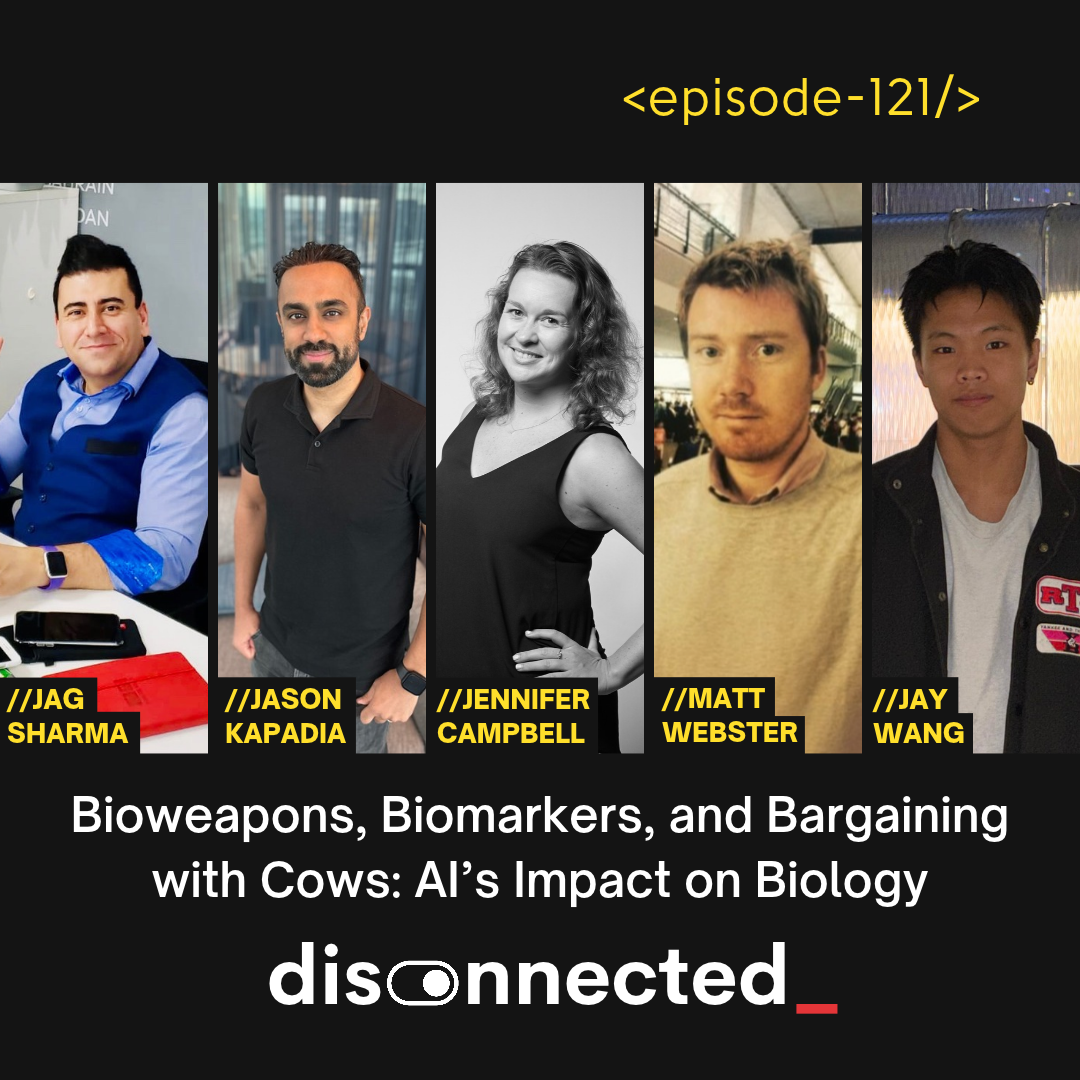
In this special episode of Disconnected, we sit down with young scientist Jay Wang to explore how generative AI is helping create new proteins, accelerate drug discovery, and whether we should be concerned about bioweapon risks and health inequality.
We also end the episode with a wonderfully weird look into the emerging world of AI that tries to open up two-way communications with whales, cows, and maybe even your dog.
This episode of Disconnected covers:
AI in Drug Discovery and Synthetic Biology
The New Bottlenecks in Medicine
Dual-Use and Biosecurity Risks
Health Data, Inequality, and Surveillance
Decoding Animal Communication with AI
Episode Highlights:
“So, what happens when generative AI stops producing things we look at on a screen and starts designing things intended to interact with the human body?” - 4:30 - Jag Sharma
“Instead of generating pictures from a text prompt like in our daily lives, these models generate a brand new protein from a design prompt, and they design proteins that have never existed after 4 billion years of evolution.” - 7:15 - Jay Wang
“Would you take a drug where scientists can prove that it works but cannot fully explain why the AI chose that particular design?” - 12:55 - Jay Wang
“There isn’t really anyone that limits you or that’s stopping you from using these AIs or these tools to design something harmful… which is actually really scary.” - 14:50 - Jay Wang
“If I choose a receptor on your neurons and look at how it functions, and I tell the AI ‘this is the receptor I want to target and here are the few parts that make it work, could you stop it from working?’, it could generate something that could target that, yes. But I'm not going to do that.” - 28:45 - Jay Wang
“The advice is going to get cheaper and cheaper with all this AI, but the treatment can stay expensive. So you can get a clearer picture of what the problem is, and you can be told earlier and more often what you should be doing - but actually getting the fix could potentially still be in these drug companies' hands.” - 33:10 - Jason Kapadia
“So we could be moving on from healthcare after symptoms to healthcare before symptoms… Personalised medicine sounds democratic until you realise that personalisation becomes something you have to pay for.” - 41:40 - Jag Sharma
“If we figure this out, this could change the relationship or the moral landscape between humans and animals. Imagine one day you're working and you get an email, and it says, ‘Urgent from the spokesperson from cows. Please stop killing and eating us. Lots of love, the cows’...” - 0:46:25 - Matt Webster
Links & references:
Jen Campbell:
https://www.linkedin.com/in/jennifer-m-campbell/
Jason Kapadia:
https://www.linkedin.com/in/jasonkapadia/
https://www.instagram.com/jasonkapadia/
Jag Sharma:
https://www.linkedin.com/in/jagsharma
https://www.instagram.com/jagsharma/
Matt Webster: